Leaders Who Don't Listen: Why Engineering Teams Stop Speaking Up
“Leaders who don't listen will eventually be surrounded by people who have nothing to say.”
— Andy Stanley
I have been the quiet engineer in the room. I have also been the tech lead who wondered why standups turned into status broadcasts with no risks, no pushback, and no bad news until production proved us wrong. After six-plus years on product teams shipping Flutter apps, Firebase backends, and store releases, I keep seeing the same pattern: the team did not suddenly get worse at communication — the room got worse at listening.
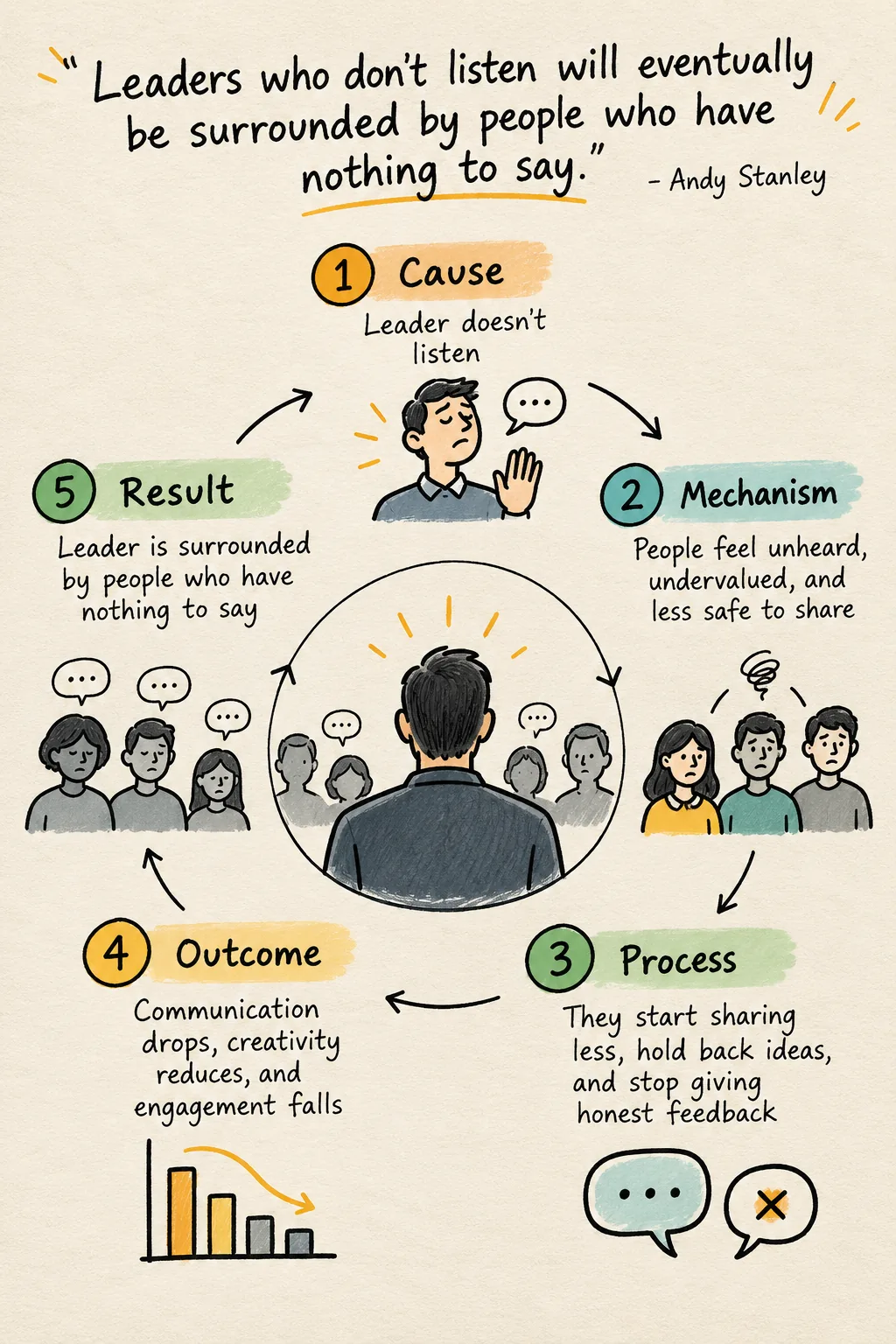
The infographic below maps that pattern as a five-step cycle. It is not a Flutter problem or a remote-work problem alone. It is a leadership loop that shows up in sprint planning, code review, founder override moments, and async Slack threads where everyone reacts with 👍 and nobody writes what they actually think.
Silence on an engineering team is rarely laziness.
It is often a rational response to what happened the last time someone spoke up.
Step 1 — Cause: the leader doesn't listen
Listening failure does not always look like shouting. On software teams it often looks like interrupting mid-explanation, deciding before constraints are clear, treating estimates as instant commitments, overriding engineers without curiosity, or multitasking through demos and 1:1s.
Founders and CTOs carry real urgency — I get it. But when speed consistently wins over understanding, the team learns: bring finished answers, not open problems. That is the first turn of the cycle.
Step 2 — Mechanism: people feel unheard, undervalued, and less safe
Engineers are not fragile; they are pattern matchers. If raising a concern led to being talked over, labeled “negative,” or ignored in the next three releases, the rational move is to stop raising it.
This is where psychological safety matters. Amy Edmondson's work describes teams where people can take interpersonal risk — admit mistakes, flag uncertainty, challenge plans — without fear of punishment. Google's Project Aristotle research on effective teams similarly pointed to psychological safety as a consistent differentiator.
On a product squad, “less safe” might mean:
- A junior dev stops asking why the Firestore model is denormalized that way
- QA stops filing “annoying but real” edge cases because they get deprioritized every sprint
- The mobile lead stops arguing about tech debt because the founder already picked a launch date on Twitter
None of that requires malice. It requires a few repeated signals that honest input is costly.
Step 3 — Process: they share less, hold back ideas, and stop giving honest feedback
Once people feel unheard, behavior changes in predictable ways:
Standups become theater — everyone reports green while flaky tests, missing APIs, and release blockers stay in DMs. Estimates get padded when honest numbers were punished last quarter. Code review goes quiet on architecture because the PR is merging Friday anyway. Remote teams go extra quiet when async feedback is ignored: threads shrink until the channel is full of 👍 and nothing meaningful is said.
Planning to build a Flutter app?
I help startups design and build scalable mobile apps with clean architecture, Firebase, and store-ready delivery.
Step 4 — Outcome: communication drops, creativity falls, engagement falls
When honest signals stop flowing, you get surprise regressions, reopened QA bugs, and rewrites that could have been refactors. Creativity falls because good ideas usually start as half-formed risks — offline sync edge cases, plugin compliance, auth failures — that never get airtime. Engagement falls when skilled engineers watch warnings come true from the sidelines and stop volunteering brainpower.
Step 5 — Result: surrounded by people who have nothing to say
This is the punchline of Stanley's quote, and it is the cruelest part of the cycle: the leader looks around and thinks the team has no opinions, no initiative, no urgency. In reality, the room is full of people who learned that opinions are not welcome.
Then the cycle repeats. The leader interprets silence as agreement, moves faster, listens even less — and the team retreats one more step.
How to break the cycle (practical moves on software teams)
You cannot fix this with a values poster. You fix it with repeated, visible behavior when listening is expensive:
- Ask before you tell — question mode first: “What did you try?” “What breaks if we skip this?” Especially when a founder overrides a senior engineer.
- Act on feedback visibly — when someone flags tech debt, QA patterns, or release risk, close the loop in public so the team sees input change outcomes.
- Safe channels for bad news — blameless retros and postmortems, private 1:1s, written RFCs; punishment teaches concealment.
- 1:1s as listening sessions — not Jira status downloads; let the second and third sentences arrive.
- Close the loop when you cannot act — “Not now, because X; we revisit on Y.” Ambiguity reads as dismissal.
Breaking the cycle is not about being softer — it is about being more accurate.
Teams that speak up catch expensive mistakes before they hit the store.
Hiring connects here too: strong candidates notice how you treat dissent in interviews. See How to Evaluate a Flutter Freelancer. If you are adding a senior Flutter engineer, they need permission to disagree on architecture and store release readiness — How to Hire a Flutter Developer in 2026 treats communication rhythm as a first-class criterion.
FAQ
Is a quiet standup always a leadership problem?
Not always. It is a problem when silence correlates with known risks — open bugs, slipping milestones, or incidents nobody raised in ceremony.
Can a senior IC fix this without executive support?
Partially. Tech leads can model listening in reviews and incidents, but if executives punish bad news, lasting change needs leaders to reward surfacing risk early.
Does remote work make this worse?
Remote does not create the cycle, but it hides silence. Use written decision records and clear async response norms (acknowledge within 24 hours, even if the answer is “not yet”).
When a second opinion helps
If your engineering team feels stuck — green standups, red production, and a backlog of “we should have said something earlier” — that is often a listening and release-readiness problem, not a framework problem. I work with founders and product leads as a senior Flutter engineer on production apps: Firebase, clean architecture, offline-tolerant flows, and store releases.
Book a free consultation at calendly.com/anghansagar25 or email hello@sagaranghan.com. You can also review Flutter app development services and case studies to see how I engage before any commitment.
Have an app idea?
Let's build something scalable together — from MVP through store release.
See case studies for production examples.